

Renvia IT
A production-ready digital platform for a UK IT recycling and asset disposal firm, built to replace phone-call bookings with an automated workflow, and to prove environmental impact with real numbers instead of vague sustainability language.
01 / The problem
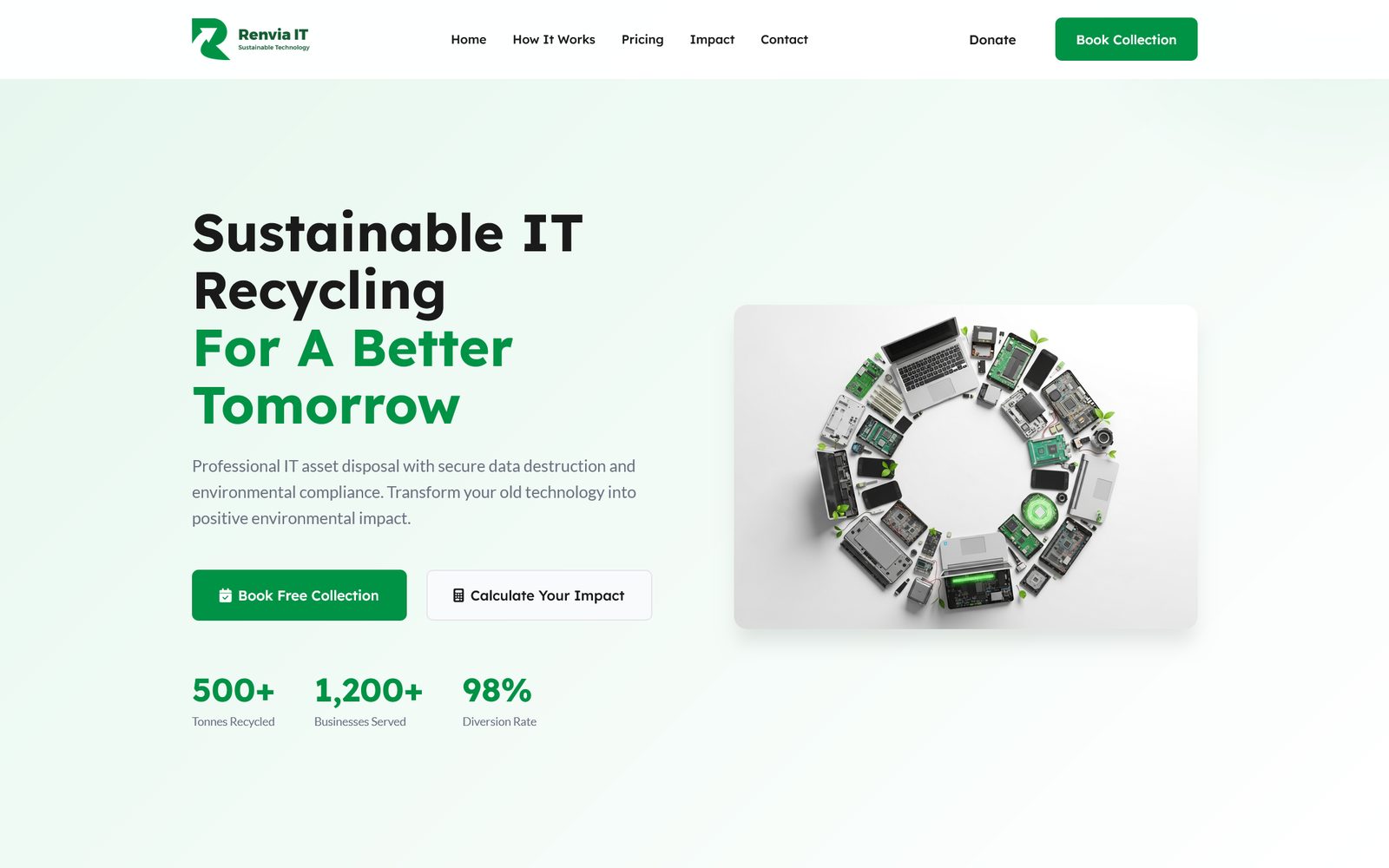
renviait.co.uk
Renvia needed more than a website. Before this build, the business ran on manual processes: phone calls to arrange a collection, spreadsheets to track what had come in, and no structured way to show a customer what actually happened to their equipment afterward. That's a real liability in this industry specifically, because a business asking companies to hand over old laptops and servers for destruction is really asking to be trusted with their data, and vague claims of "we recycle responsibly" don't establish that trust on their own.
The sector's second problem is audience split: a corporate IT manager needs compliance documentation and bulk booking, while an individual just wants to drop off an old phone without wading through enterprise language built for someone else.
Add UK regulatory requirements around GDPR and secure data destruction, and a stated plan to eventually launch an asset recovery marketplace, and the brief was clearly for a scalable system, not a brochure that would need a rebuild the moment the business added its next capability.
02 / The thinking
I rejected leading with pricing or a generic three-icon "how it works" section, which is what most competitors in this space default to. Trust in this category gets earned through specifics, so the site leads with the compliance credentials that actually matter to a buyer's own compliance team: ISO 14001, ISO 27001, and Environment Agency licensing, stated plainly rather than implied.
I rejected treating environmental impact as marketing copy. A live calculator translates a collection into concrete figures, CO2 saved, kilograms diverted from landfill, expressed with equivalence indicators a non-technical reader immediately understands, because "we're sustainable" convinces nobody, and a number does.
For the audience split, I rejected trying to serve both corporate and individual users through one shared interface with optional fields. Instead the two flows are architecturally separate from the start, corporate booking assumes bulk equipment and asks for compliance documentation upfront, individual booking stays to the minimum fields needed to arrange a single collection, and the platform is structured so a backend can eventually apply proper role-based access without redesigning either flow.
What the platform actually does
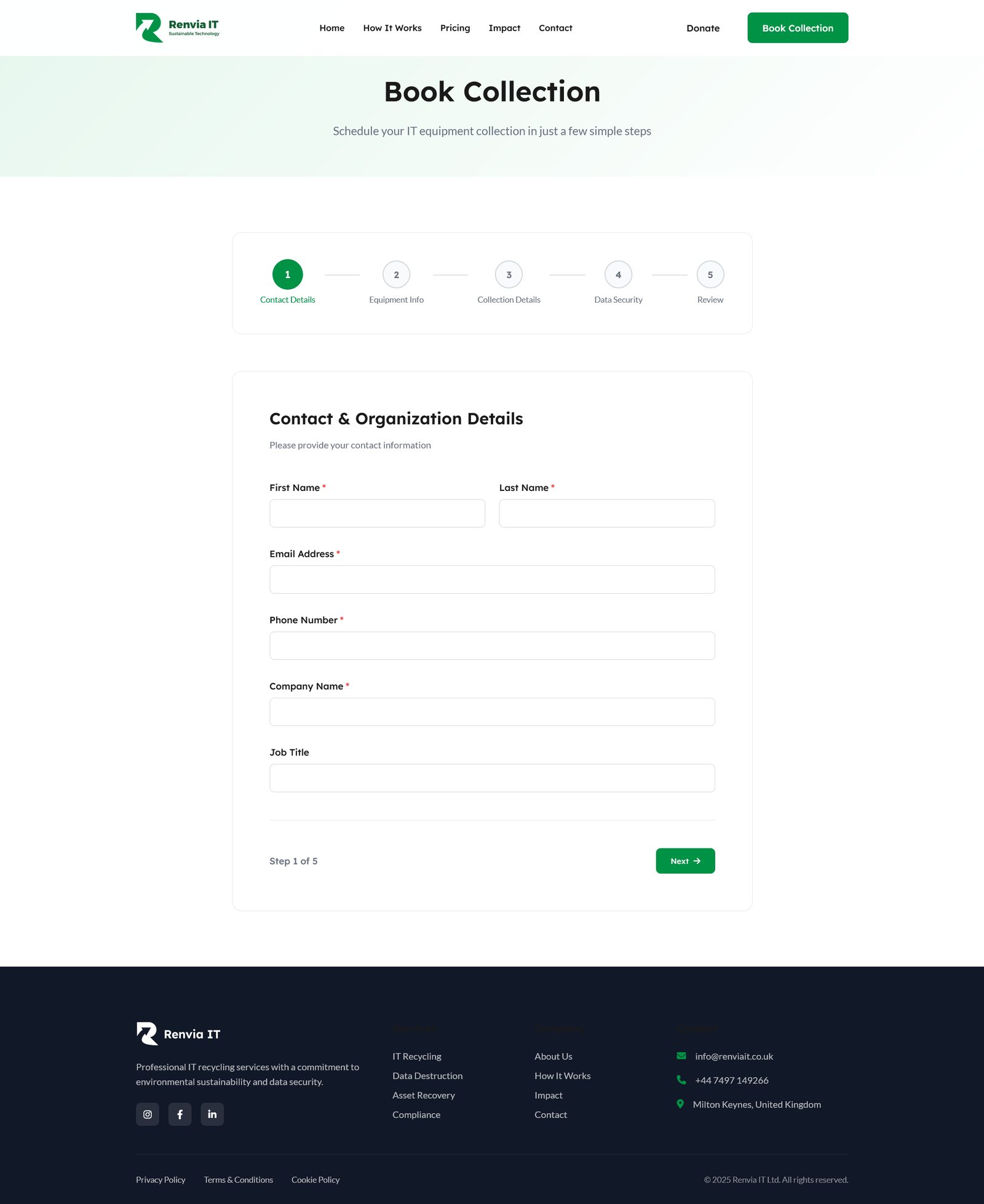
Booking system
Equipment selection, scheduling, a choice between data wiping or physical destruction, and a tracked confirmation, replacing what used to be a phone call and a spreadsheet entry.
Impact calculator
Real-time CO2 savings and landfill diversion figures, with equivalence comparisons that make an abstract number concrete.
User dashboard
Booking history, cumulative environmental impact over time, and account preferences in one place.
Donation portal
A distinct CSR workflow for corporate and individual device donations, generating ESG-ready impact reporting for a stakeholder audience.
Authentication layer
Secure sign-up and role-based views for B2B versus B2C, built to connect to enterprise SSO later without a rebuild.
PWA-ready architecture
Installable, offline-aware, and built with structured state persistence so a multi-step booking survives an interrupted session.
renviait.co.uk/book
03 / The business, the users, and the constraints
The service itself is free to the customer, which had to be communicated without looking low-budget, since undervaluing the presentation would quietly undercut the compliance-grade positioning the rest of the site works to build. "Free collection" and "full documentation provided" needed to be impossible to miss on the first screen, not buried three clicks into an FAQ, because that's the specific reassurance an IT manager is scanning for.
Technically, the entire frontend is HTML5, CSS3, and vanilla JavaScript with no framework, structured deliberately so a real backend (Node, Firebase, or Supabase) can be added later without an architectural rewrite. Client-side validation and controlled error handling were treated as production requirements from day one, not polish added at the end, since a multi-step booking form that fails silently is worse than the phone call it replaced.
04 / The outcome
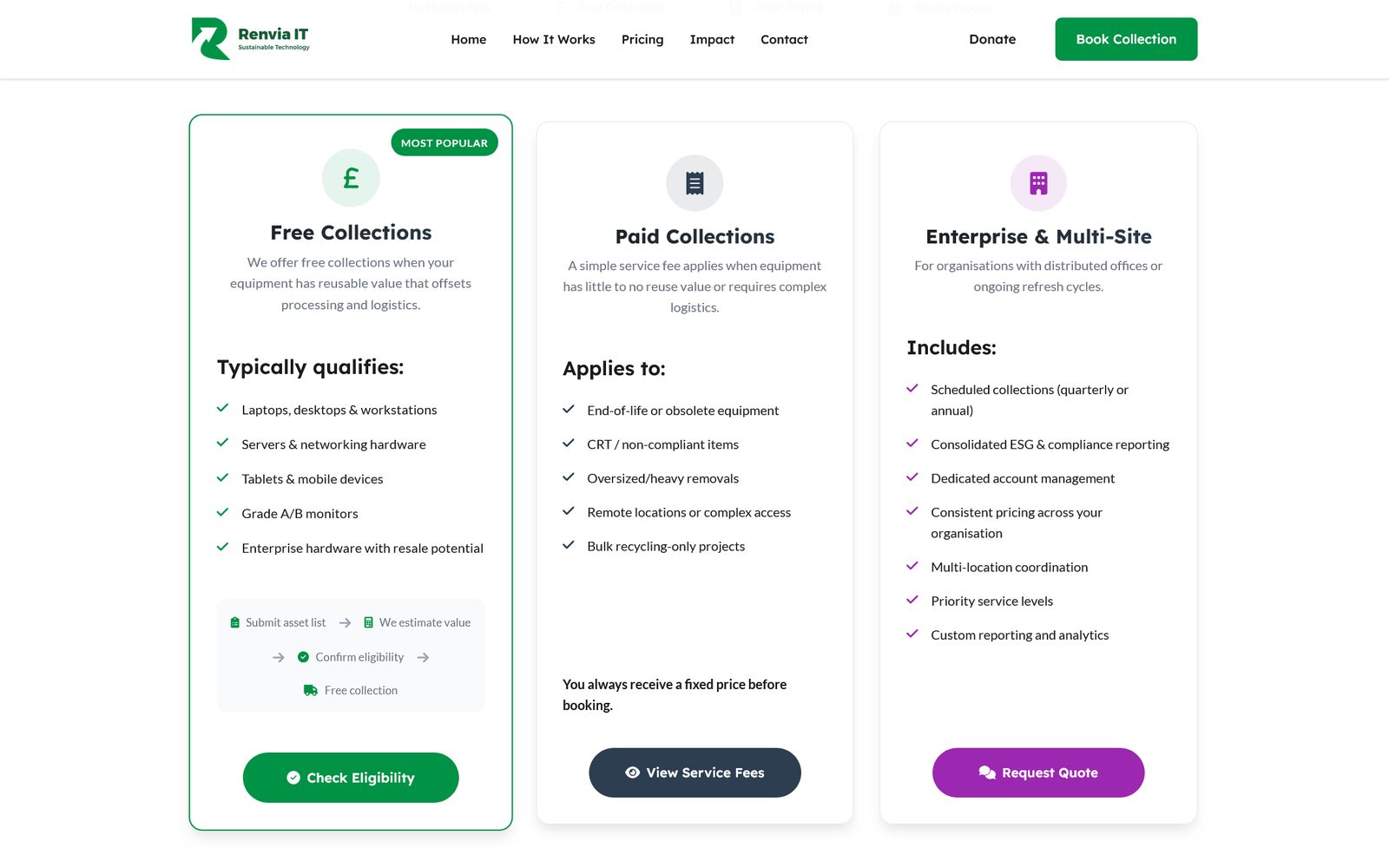
renviait.co.uk/pricing
Live, taking real collection bookings directly through the platform, with recycling and CO2 impact metrics presented as ongoing, visible proof rather than a one-time claim on an About page. The clearest lesson from this build: sustainable businesses need digital infrastructure, not decoration. The most effective environmental platforms don't just state their impact, they make it measurable, visible, and personal to whoever's looking at it, and that discipline of proof, not adjectives, is what actually earns trust in a sector this skeptical of vague claims.
500+tonnes recycled, stated on site
1,200+businesses served, stated on site
98%landfill diversion rate
2ISO certifications led with