

WorkPulse
A team operating system that replaces the six tools a growing company usually stitches together to run itself: tasks, projects, goals, CRM, analytics, and HR, plus AI agents that watch the work and escalate what a manager would otherwise miss.
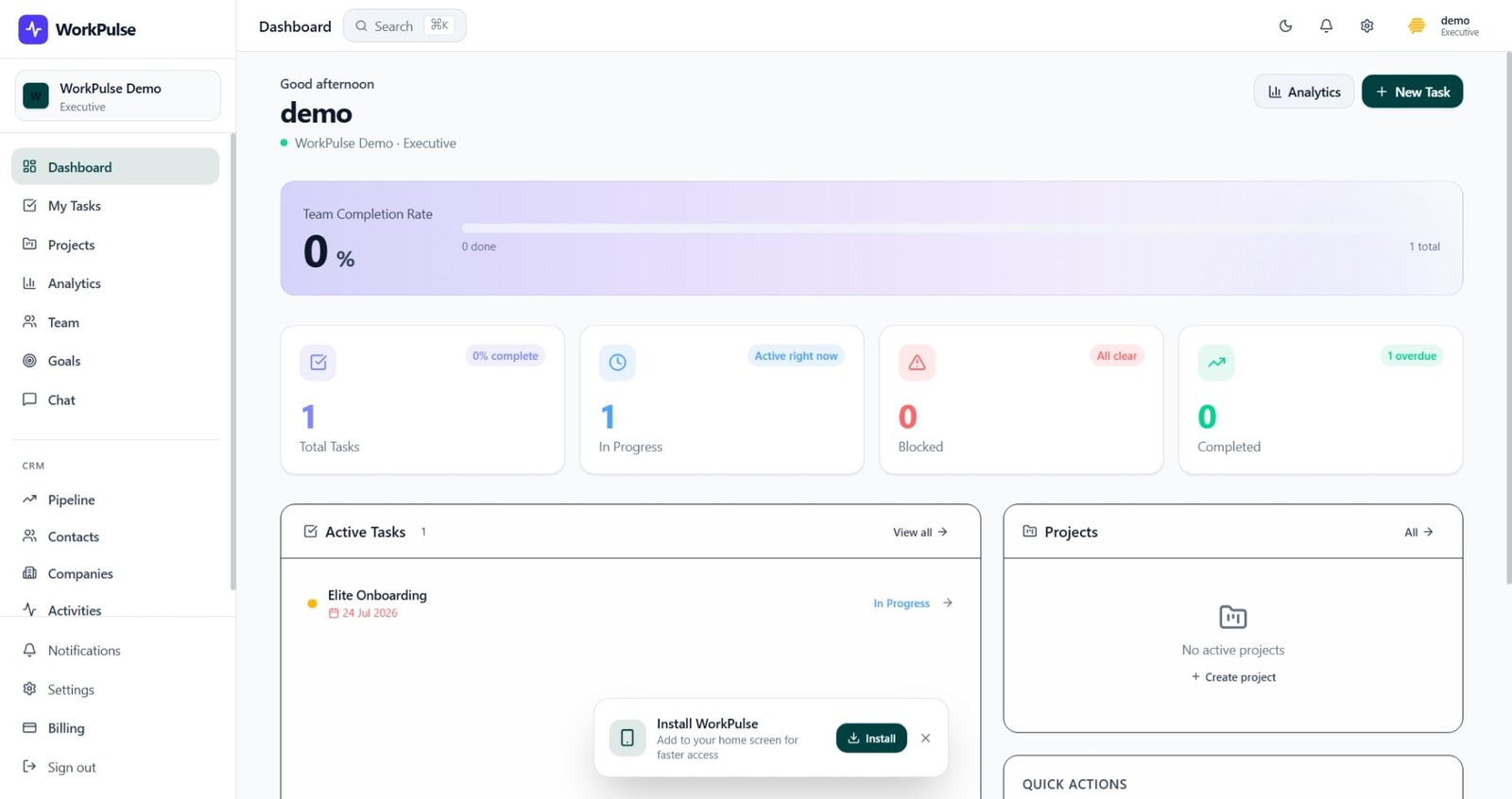
Every growing team hits the same wall. Tasks live in one app, sprint tracking in another, the CRM somewhere else, HR and leave requests in a spreadsheet, and performance reviews in whatever the manager remembers from Slack. Nobody owns the full picture, so managers spend their week reconstructing status instead of unblocking people.
The expensive part isn't the six subscriptions. It's that nothing in any of those tools talks to the others, so blockers sit unnoticed until they've already cost a deadline.
I'd watched this happen inside two client engagements before I built WorkPulse: a blocked task would sit for four days because the person who needed to know wasn't looking at that board that week. That's not a tooling gap. It's a visibility gap, and visibility gaps are a design problem before they're an engineering one.
The obvious move is to clone Asana or ClickUp and add a chatbot. I rejected that early. Startups already resent paying for six tools; giving them a seventh generalist tool with an AI label on it solves nothing. The actual opportunity was consolidation with judgment built in, not another list-of-lists.
I also considered building WorkPulse as a set of integrations that sat on top of a team's existing stack (Asana plus Slack plus HubSpot, wired together). I rejected that too: integrations break the moment any partner changes their API, and I'd be shipping fragility as a feature. A single data model, owned end to end, was slower to build and far more durable.
The one idea I kept from the chatbot instinct was agents, but reframed: not something you talk to, something that watches the data and acts. A blocker sitting for 48 hours should escalate itself. A goal falling behind its trajectory should flag itself on Sunday, before Monday's planning meeting, not after.
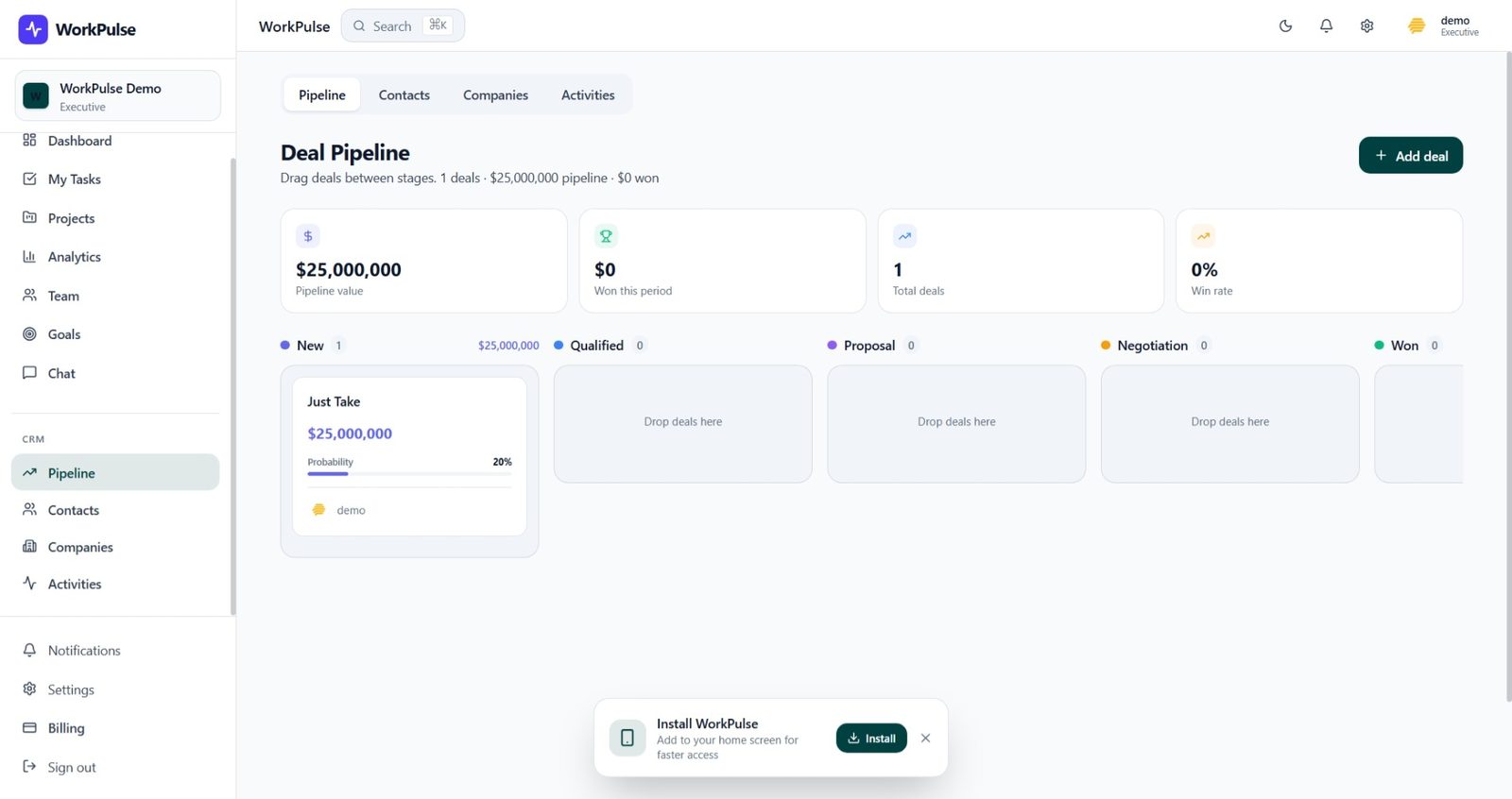
WorkPulse had to work as a business, not just as software. Startups and small teams (five to fifty people) are price-sensitive and will not pay enterprise rates for a tool they're not sure they'll still use in six months, so a genuinely usable free tier was non-negotiable, with the upgrade path sitting behind CRM, advanced analytics, and enterprise permissions rather than behind basic task management.
Agencies and consultancies needed client project tracking and a CRM in the same place they track their own delivery work, so I built both into the core product instead of treating CRM as a bolt-on module. And because a meaningful share of the market I know best is African and remote-first, WhatsApp notification support and offline-friendly PWA behaviour weren't nice-to-haves, they were the difference between a tool that gets adopted and one that gets abandoned after week two.
Four roles use WorkPulse differently, and the interface has to respect that instead of showing everyone the same dashboard. An executive wants a KPI score and an audit trail. A manager wants to know what's blocked and who's overloaded. A team lead wants their board. Staff want to open the app, see three things that matter today, and get back to work.
That's why the dashboard leads with a completion rate and stat cards before it shows a single task list, and why permissions are role-based rather than a single flat view with everything visible to everyone. Watching people status-update by hand in Slack was the clearest signal that the daily digest agent needed to exist: it's the report a manager was already writing themselves, just automated and delivered before their first coffee.
Illustrative module map, not a screenshot. Every module below reads and writes the same workspace-scoped data, which is what makes the AI agents possible in the first place.
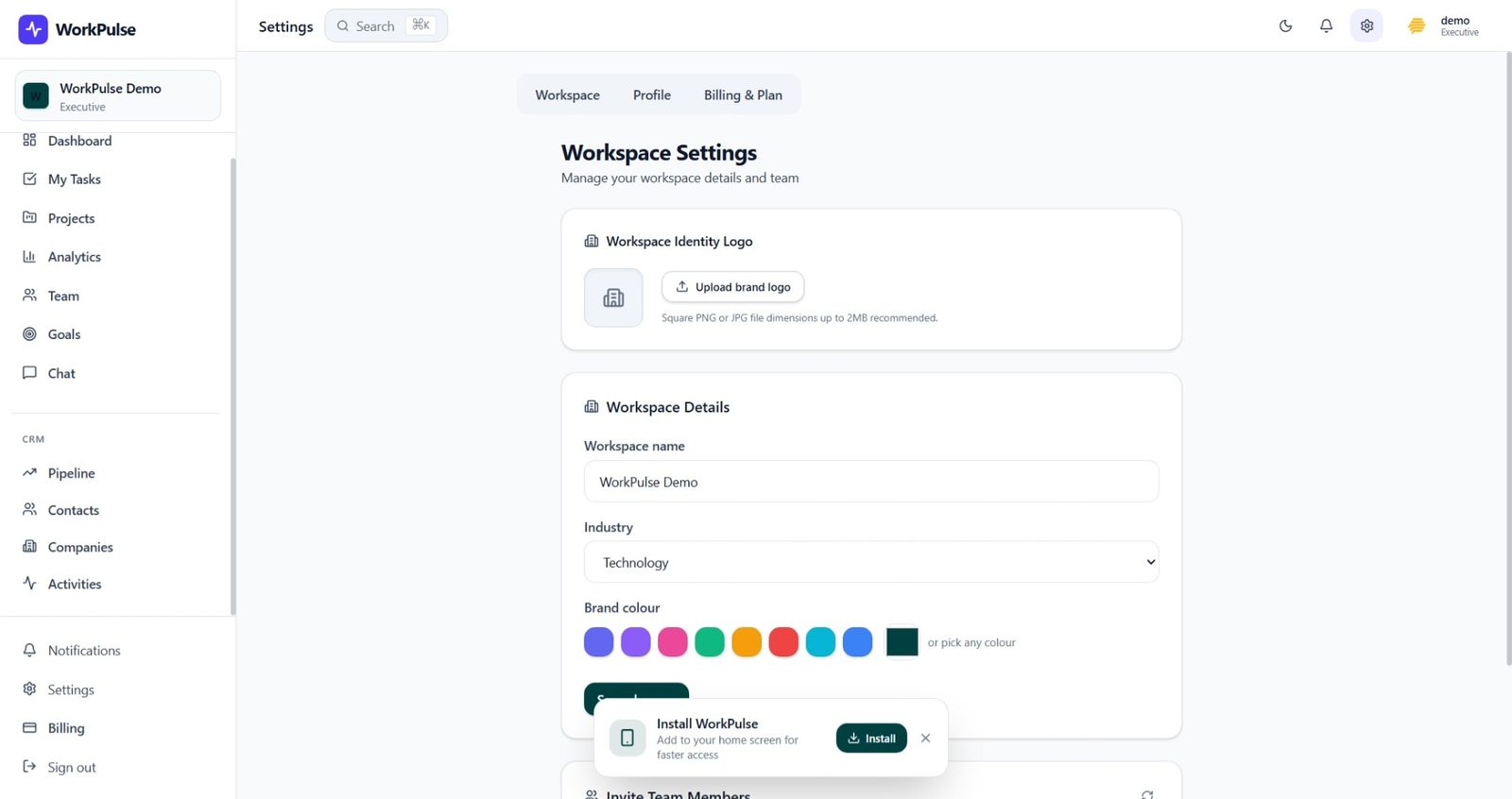
This was built and shipped by one person, which set the real limits. Every feature had to justify its maintenance cost, not just its build cost, so I chose Supabase over a custom backend specifically to avoid owning auth, storage, and realtime infrastructure myself. AI calls run through Groq first for speed and fall back to Gemini, because a single-provider dependency is a business risk I wasn't willing to carry into a product with paying customers.
Row-level security had to be correct on the first pass, not patched in later, because retrofitting workspace isolation into a live multi-tenant product is one of the more dangerous refactors in software. That constraint shaped the schema before a single screen was designed.
WorkPulse is in production on Vercel with a Supabase backend, and it's the platform I now use to run my own client work, which is its own kind of proof. I haven't run a formal customer study yet, so I won't dress up a usage number as market validation. What I can state plainly: the build itself reached a scope most teams would staff with three or four engineers, shipped by one.