

Trendova
A cash-on-delivery storefront and order system for Nigerian sellers who currently run their entire business through WhatsApp, Instagram, and a spreadsheet. One shareable product page, one order form, and a dashboard that replaces the spreadsheet.
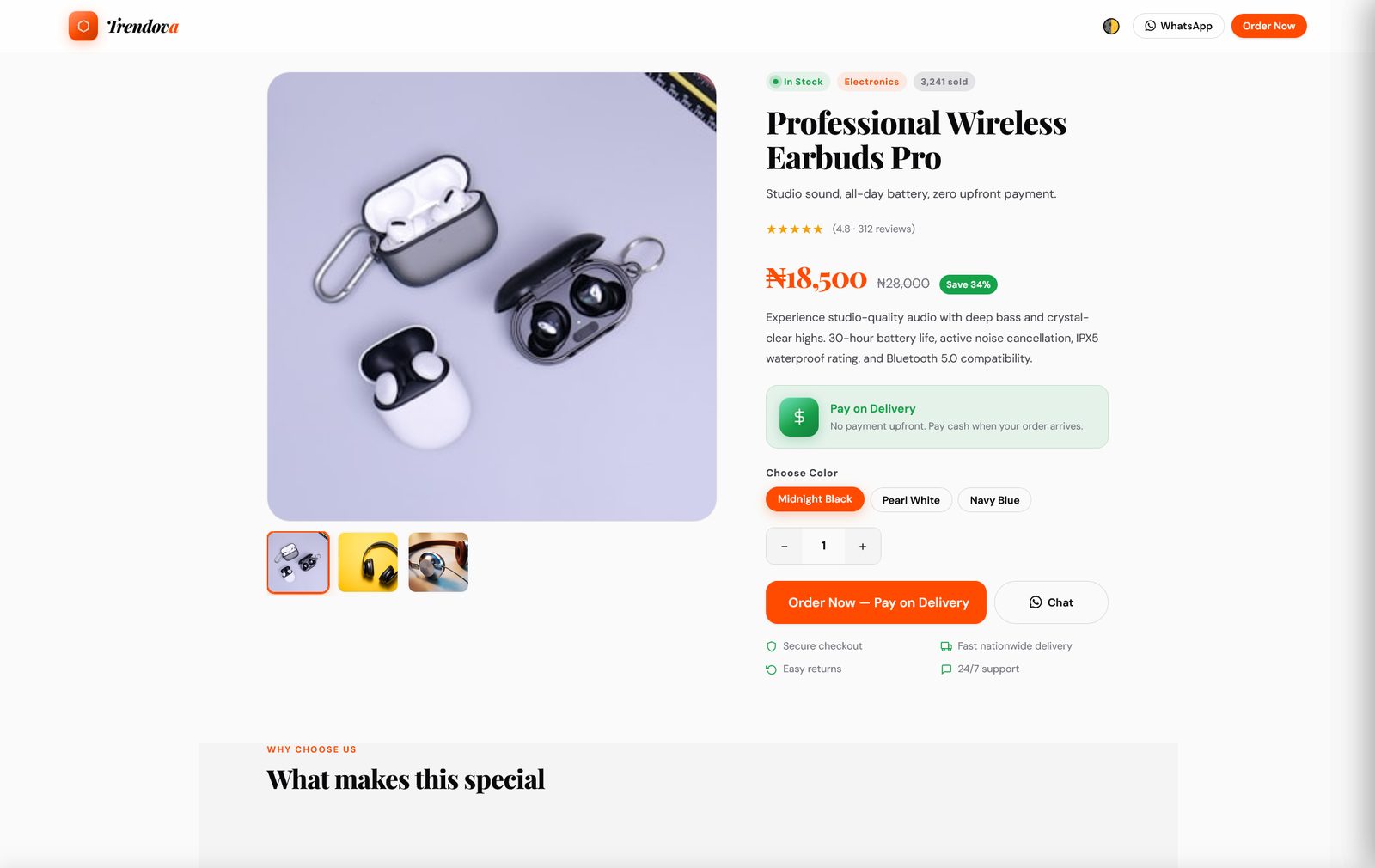
Most Nigerian mini-importers and social commerce sellers run their entire operation through WhatsApp for orders, a spreadsheet for tracking, and phone calls to confirm delivery addresses. It works until it doesn't: orders get missed in the DM backlog, nobody can say what last week's revenue actually was, and every new product means rebuilding a landing page from scratch because there isn't one to reuse.
The business cost isn't the missed sale. It's the failed delivery, when a rider arrives at an address nobody actually confirmed, and the seller eats the cost both ways.
Before Trendova
- Orders scattered across WhatsApp threads
- Revenue tracked by hand in a spreadsheet
- Addresses confirmed by phone call, if at all
- A new landing page built from zero per product
After Trendova
- One order form, structured, saved to a database
- Revenue and delivery rate on a live dashboard
- State, address, and phone captured at checkout
- Reusable product page, edited without code
I considered building Trendova as a full e-commerce platform with accounts, carts, and online payment. I rejected that for this market: cash-on-delivery is the trust mechanism these buyers actually use, since card payment fraud fear runs high and few shoppers here trust a storefront they've never bought from before. Adding a checkout flow that assumes card payment would have solved a problem this seller doesn't have, while ignoring the one they do: turning a DM into a confirmed, trackable order.
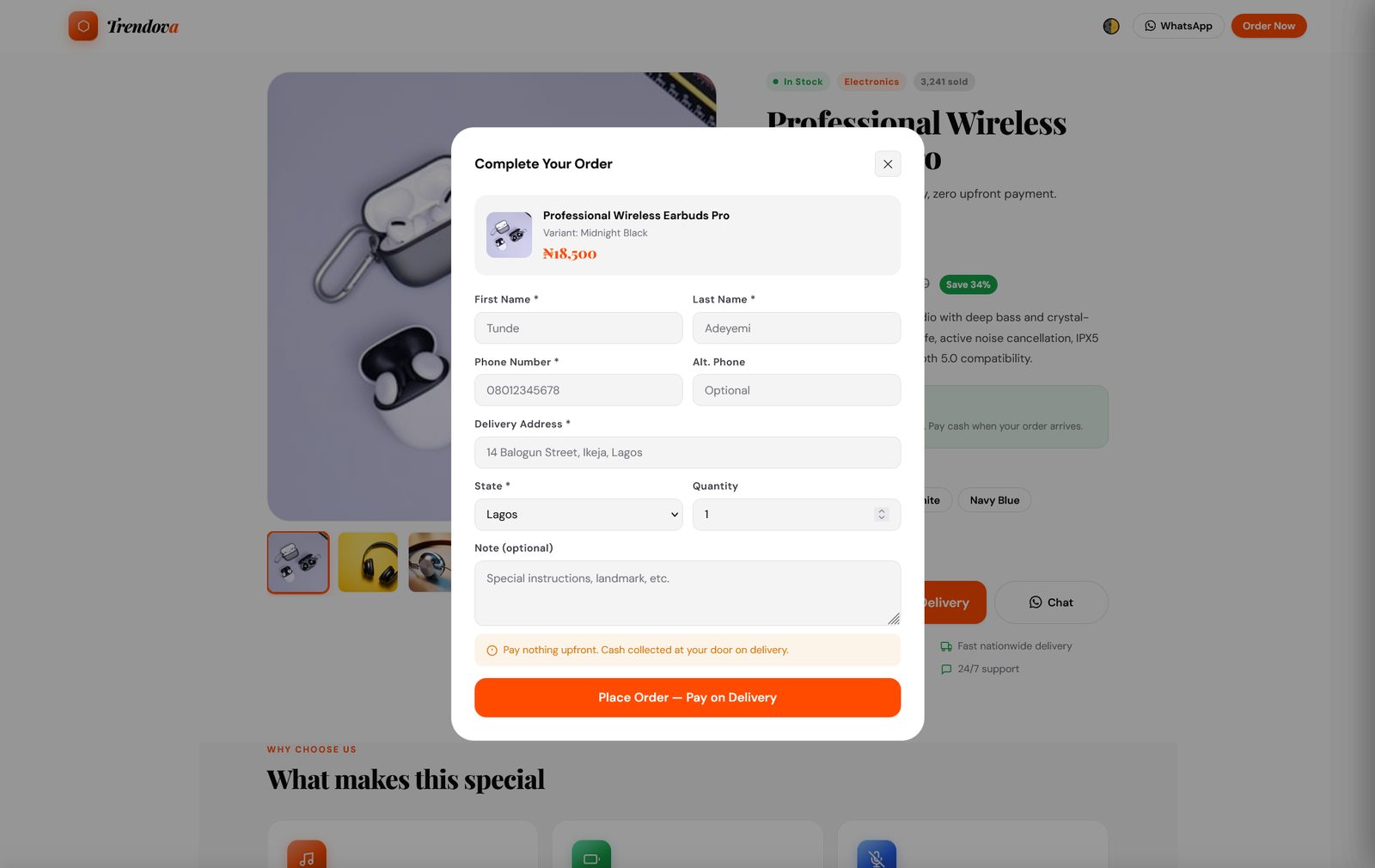
The order form asks for exactly what's needed to fulfil the order: name, phone, address, state, and quantity. No account creation, no password, no email required. A customer arriving from a Facebook or TikTok ad decides and orders in the same visit, because every extra field between a decision and a submit button is a customer who closes the tab instead.
The moment an order lands, the seller gets it on WhatsApp and by email, with the customer's details pre-filled into a click-to-chat link, so confirming the order is one tap, not a search through a DM history.
The seller this is built for isn't going to hire a developer to add their next product. So the Page Editor lets them change headline, description, price, and media themselves, and a new product page goes live without touching code or waiting on me. That single decision is the difference between a tool a seller actually keeps using and one they abandon after the first edit request.
I built it as pure HTML, CSS, and JavaScript with no framework and no build step, deliberately. It deploys to Vercel as a static site, which means zero hosting cost pressure on a seller running thin margins, and zero build pipeline that can break between me handing it over and them running it day to day.
Trendova is live and client-operated, handling real orders through Supabase with automated WhatsApp and email alerts on every submission. I don't have the client's full sales figures to publish here, so I'll say what I can verify directly: failed deliveries traced back to bad address data are the specific failure mode the order form was built to close, because every field on it exists to prevent exactly that call from a rider standing at the wrong door.